

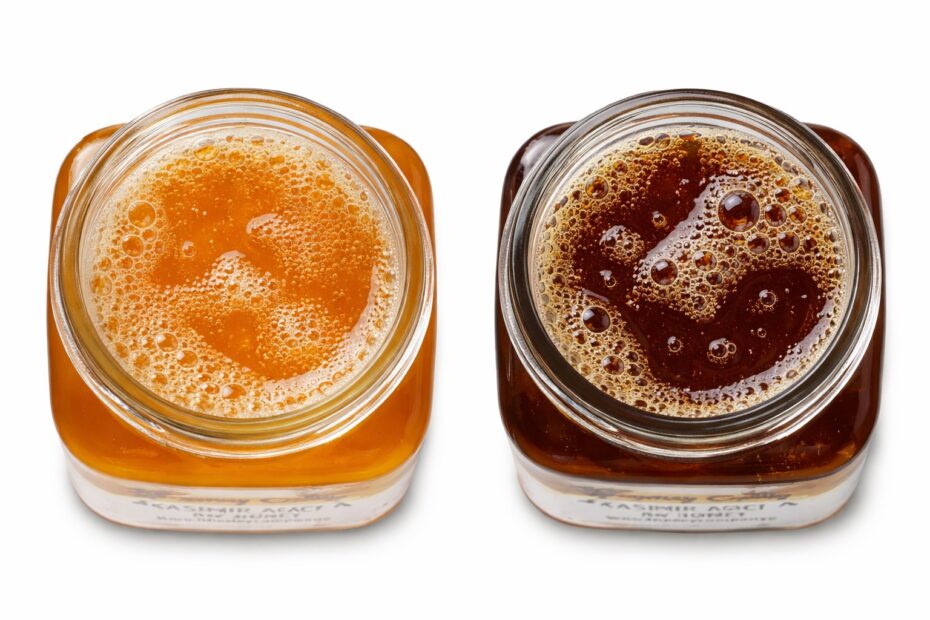
Why Are There Bubbles or Gas in Honey?
Bubbles in honey are something people occasionally notice when they open a jar, especially during very warm weather. They may also notice a slight build-up of gas which shows when you open the lid; you will hear a pop or slight fizzy sound. This can be surprising if you have never experienced it before.
Since honey is a natural product made by bees, small changes can sometimes happen depending on the season, temperature, moisture level and how the honey has been stored. One of these changes can be the appearance of bubbles or light foam in the jar, especially during very warm weather.
Scientific studies have shown that naturally occurring yeasts present in honey can ferment sugars under suitable moisture and temperature conditions, producing carbon dioxide gas which may appear as bubbles in the honey (White, 1975; Snowdon & Cliver, 1996).
This article explains why bubbles appear in honey and what they usually mean.
Why Do Bubbles Form in Honey?
It could quite simply be air trapped in the act of pouring the honey into the jar, that rises to the top. Or it could be the fact that raw honey naturally contains sugars, tiny amounts of pollen, enzymes, and traces of naturally occurring yeast from the environment.
Under certain conditions — especially when the weather is very warm — these natural yeasts may begin to slowly act on the sugars in honey. When this happens, a small amount of gas can be produced, which appears as tiny bubbles inside the honey.
This is a natural process sometimes referred to as mild fermentation.
Because honey sold by responsible producers is usually raw or minimally processed, it still contains its natural components. That is why small natural changes like this may occasionally occur.
Warm Weather Can Encourage This
Temperature plays a big role.
During very hot months, especially in places where daytime temperatures regularly cross 30–35°C, natural activity inside the honey can speed up slightly. This can sometimes lead to the formation of small bubbles.
This is more likely to happen when jars are stored in warm kitchens, near stoves, or in direct sunlight.
Do Bubbles in Honey Change Taste?
In many cases, people notice bubbles but find that the honey smells exactly the same and tastes the same as always.
When this happens, it usually means the change is very mild and recent or is just trapped air, and the honey itself has not developed any sour or fermented flavour.
If fermentation continues for a long time, honey may eventually develop a noticeably sour smell or tangy taste, which is quite easy to recognise.
How to Store Honey if You Notice Bubbles
Honey stores very well, but a few simple precautions help maintain its natural balance.
Keep honey in a cool place
Try to store raw honey in the coolest part of the house, away from direct sunlight or heat.
Close the lid tightly
Honey can absorb moisture from the air, so it is best to keep the jar properly closed when not in use.
Use a dry spoon
Always use a clean, dry spoon when taking honey from the jar. Introducing water into the jar can disturb honey’s natural balance.
Use the Refrigerator (If Bubbles Are Already Present)
If you notice that the honey has already developed bubbles and gas is building up, it is best to store the jar in the refrigerator. You can take out the quantity you need each day and return the jar to the fridge. This is particularly useful when the honey is stored in glass jars. If fermenting honey is kept outside in warm conditions, the gas produced can cause pressure to build up inside the jar. Over time, this pressure may push the lid up or, in rare cases, even crack the jar.
However, do keep in mind that refrigeration will make raw honey crystallise faster, causing it to become thicker and grainy. This is a natural change and does not affect the quality of the honey. If you would like to know more about crystallisation click here.
A Note About Raw Honey
Unlike highly processed sweeteners, honey is a natural agricultural product. Its properties can vary slightly depending on the flowers the bees visit, the season, and the climate.
Because raw honey still contains its natural enzymes and pollen, it can sometimes show natural changes over time such as:
-
crystallization (becoming thick or grainy)
-
the occasional appearance of bubbles during very warm weather
These are simply characteristics of natural honey.
In Simple Terms
If you notice a few bubbles in honey, especially during hot weather, it is usually the result of natural activity within the honey itself.
A quick check is usually enough:
-
Does it smell like normal honey?
-
Does it taste the same as usual?
If both are unchanged, then bubbles in honey are simply a natural change that can happen in raw honey, especially in hot weather.
FAQ’s
Why does honey develop bubbles?
Bubbles can form when natural yeast in honey slowly acts on sugars, especially in warm weather.
Does bubbly honey mean it has gone bad?
Not necessarily. If the smell and taste remain normal, the honey is simply showing a natural change that sometimes occurs in raw honey.
Can heat cause bubbles in honey?
Yes. Warm temperatures can encourage natural activity inside honey, which may produce small bubbles.
How should honey be stored in summer?
Honey should be kept in a cool place, away from sunlight, with the lid tightly closed.
At The Honey Company, we offer several varieties of premium raw honey sourced from forests and plantations across India. Each variety is 100% natural and unique. You will enjoy this adventure of discovering what real honey tastes like.